
GSO for E-commerce: Driving Direct Answers for Product Queries
Where E-commerce Wins in Generative Search
Generative search compresses the path from question to purchase. Instead of scanning ten blue links, shoppers increasingly ask for a direct recommendation, a shortlist, or a clear "best fit" based on constraints like budget, sizing, delivery speed, or compatibility. Platforms are also expanding AI summary experiences inside search itself, which changes what "visibility" looks like for product discovery.
For e-commerce brands, GSO is about making product information easy to retrieve, easy to trust, and easy to reuse in direct answers. That means building product pages and supporting content that can be quoted cleanly, backed by structured data, and connected to strong product entities.
How Shoppers Use Generative Search for Product Decisions

Shoppers tend to use generative search in a few recurring ways:
Constraint-led queries
People describe the job to be done, then add limits. Examples include "best running shoes for wide feet under $200" or "carry-on suitcase that fits airline limits and weighs under 3kg". This behaviour aligns with the shift toward more conversational, long-form searching that AI summary experiences are designed to support.
Comparison and trade-off questions
Queries like "X vs Y" and "is it worth upgrading" require clear differentiation: who it is for, key specs, practical outcomes, and what changes between variants.
Confidence checks close to purchase
Shoppers seek confirmation on sizing, durability, warranty, returns, shipping cut-offs, and real availability. If your pages present these facts clearly (and consistently across page, schema, and feed), they are more likely to appear in direct answers.
Multi-step shopping journeys inside AI tools
AI assistants are adding richer shopping experiences with images, reviews, and direct links, often using structured metadata from third parties. That increases the value of clean, standardised product attributes, and identifiers across the web.
See our article on Semantic Content for how topic layering supports these kinds of conversational product queries.
Structuring Product Content So It Can Be Used in Direct Answers
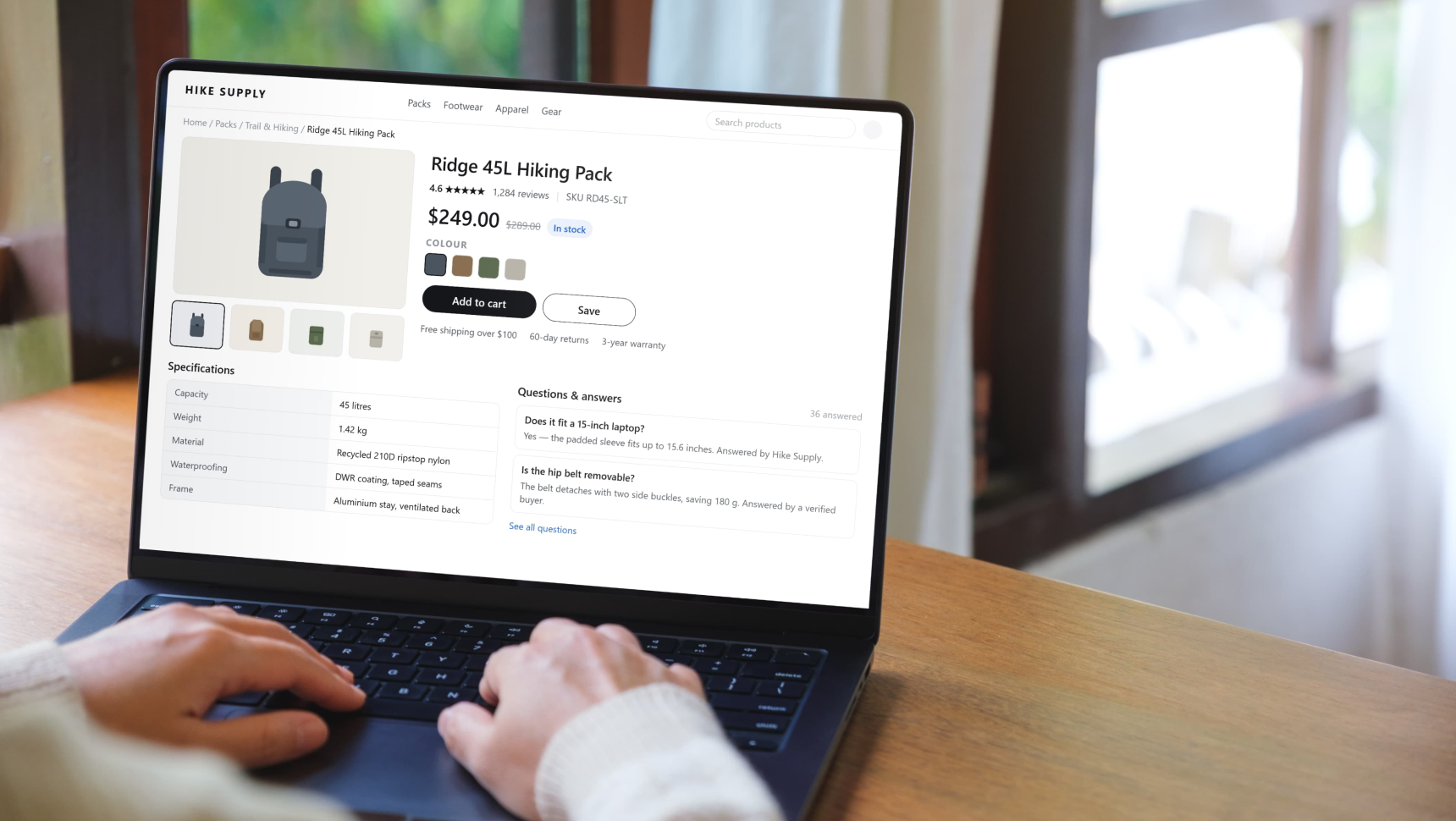
Product pages need to work for humans first, while remaining "extractable" for answer systems.
Lead with an answer-ready product summary
Place a short "What it is" and "Who it is for" section high on the page. Keep it factual and specific. Include:
- Product type + primary use
- Key differentiator that is measurable (materials, capacity, dimensions, compatibility)
- One or two common fit notes (sizing, skin type, device model, room size)
Add a buyer-focused Q&A block
Include a section titled with the shopper's language, such as "Common questions" or "Before you buy". Each question should be a single line, followed by a short, direct answer that can stand alone. Focus on:
- Sizing and fit guidance
- Shipping timeframes and cut-offs
- Returns and warranty coverage
- Compatibility, inclusions, and setup
- Care instructions and expected lifespan under normal use
Create comparison elements that reduce ambiguity

Direct answers often need clear differences. Useful components include:
- Variant comparison tables (size, colour, capacity, weight, included accessories)
- "Compare models" sections on category pages
- "Works with" or "Pairs well with" blocks for compatibility and bundles
Keep the facts consistent across the site
If a product's capacity is "1L" in one place and "1000ml" in another, you introduce retrieval uncertainty. Standardise:
- Units of measure
- Naming conventions for variants
- Stock status wording
- Warranty and returns language
Enhancing Product Entities so Platforms Can Recognise and Trust Them
In generative search, "being understood" is a prerequisite for "being chosen". Product entities get stronger when identifiers and attributes are complete, consistent, and connected.
Use globally recognised identifiers where possible
For many retail products, unique product identifiers help platforms classify and match listings accurately. Google Merchant Center highlights GTINs as a key attribute that helps products become easier to find, and products without unique identifiers can be harder to classify.
Where relevant, ensure you consistently provide:
- Brand
- GTIN (or MPN where appropriate)
- Accurate model names and variant identifiers
Strengthen attribute completeness, not only descriptions
Well-written copy helps, and attributes often decide whether a product can be surfaced for a constraint-led query. Build a consistent attribute set per category, such as:
- Dimensions, weight, materials
- Battery life, capacity, compatibility
- Care instructions, certifications, country of origin (where relevant)
Support product intent with adjacent semantic content
Product pages alone rarely cover every question. Add supporting pages that connect to products and can be cited in answers, such as:
- Sizing guides
- Compatibility guides
- Shipping and returns hub pages
- Care and maintenance guides
- "How to choose" explainers for major categories
These pages reinforce meaning and context, and they help answer systems link your products to the right use cases.
Technical Optimisation for Product Answers and Rich Results
Technical signals make your products easier to retrieve, parse, and reuse.
Implement Product structured data with complete fields
Google's documentation notes that Product structured data can enable richer presentation in search, including price, availability, ratings, shipping information, and more.
Prioritise accurate markup for:
- Product with clear name, description, image
- Offers with price, priceCurrency, and availability
- AggregateRating and review only when your review system meets policy requirements
Schema.org defines Product and AggregateRating types used across the ecosystem.
Align on-page content, schema, and feeds
Many platforms reconcile multiple sources of truth. Keep these aligned:
- On-page price and availability match schema
- Schema matches Merchant Center feed attributes where used
- Variant handling is consistent across URLs, canonical tags, and structured data
Google's Merchant Center product data specification outlines the kinds of attributes used to build shopping experiences across Google surfaces.
Make crawl and indexing predictable at scale
For large catalogues, prioritise:
- Clean indexation rules for faceted navigation
- Canonicals for variant and filter URLs
- Fast, stable rendering for product pages
- Accurate XML sitemaps that include only indexable URLs
- Strong internal linking from categories to products and from guides to products
Optimise for trust and retrieval quality
Answer systems tend to favour sources that are clear and verifiable. Practical trust signals include:
- Prominent business details, contact options, and policy pages
- Up-to-date dateModified on guides and key policy pages when changes occur
- Consistent brand entity markup (Organisation schema) across the site where appropriate
Microsoft has also highlighted schema as a way to help AI systems interpret content confidently, including product-related markup.
Bringing It Together for Answer-Box Visibility in E-commerce
Direct answers for product queries are earned through clarity, entity strength, and technical consistency.
When product pages contain answer-ready summaries, complete attributes, and reliable structured data, they become easier to select for conversational shopping queries and comparison prompts. When those pages are reinforced by semantic guides and clean site architecture, your catalogue becomes easier to retrieve across generative search experiences.
For how direct answers are assembled and where brands can appear, see The Role of the Answer Box in GSO.
Want your products to show up in AI powered search? Connect with us.