
Building a Foundational Knowledge Graph for Your Brand
Why Brands Need Structured Knowledge in the Age of AI Search
Search has evolved from keyword matching to entity understanding. Modern search systems interpret people, organisations, products, locations, and concepts as identifiable entities connected through relationships. This shift has major implications for how brands build visibility online.
Generative AI systems such as search assistants, conversational agents, and AI summaries rely heavily on structured knowledge rather than traditional ranking signals alone. When these systems answer questions, they frequently draw on knowledge graphs to understand how entities relate to one another. A brand with a clear, well-structured entity footprint is therefore easier for AI systems to recognise, verify, and reference.
For organisations investing in Generative + Search Optimisation (GSO), building a foundational knowledge graph is a critical step. It ensures that search engines and AI agents understand what your brand is, what it offers, and how it connects to the broader digital ecosystem.
A knowledge graph strengthens a brand's authority signals, improves discoverability in AI answers, and enables more accurate attribution when content is referenced. Instead of relying solely on pages and keywords, the brand becomes a recognised entity within a structured network of information.
This article explains how knowledge graphs work, how organisations build them, and why they play such an important role in AI-driven search environments.
Understanding Knowledge Graphs in Modern Search
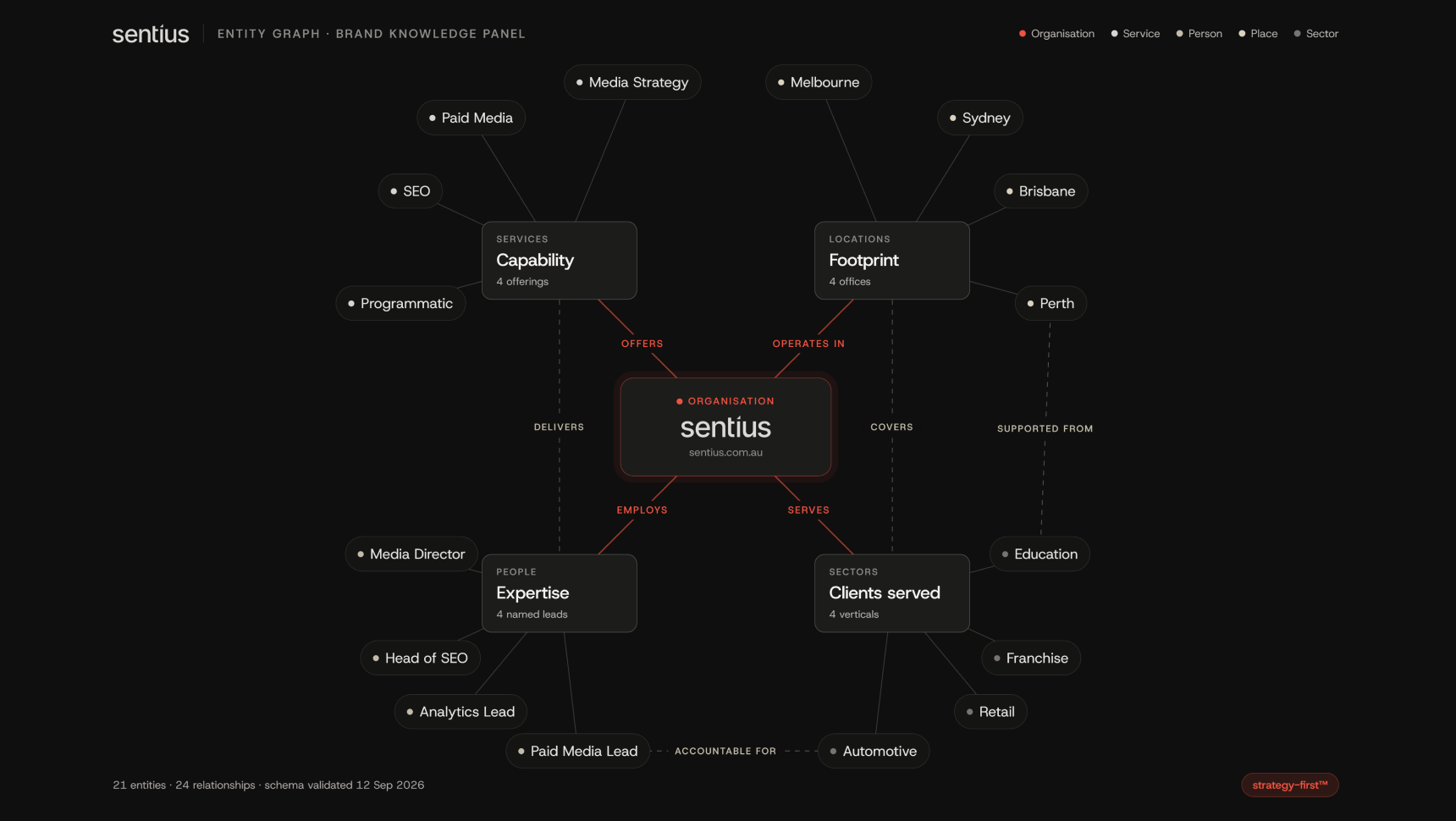
A knowledge graph is a structured representation of information that maps entities and the relationships between them. Entities may include people, companies, products, places, concepts, or events. The relationships between them form a network that allows machines to interpret context and meaning.
The concept became widely known after the introduction of the Google Knowledge Graph, which was designed to improve search results by understanding real world entities rather than simply matching keywords.
In a knowledge graph, information is organised through a simple but powerful structure:
- Entities represent identifiable things such as a company, product, or individual
- Attributes describe those entities such as founding date, location, or category
- Relationships connect entities to each other
For example, a brand entity might be connected to:
- Its founders
- Its products or services
- Its headquarters location
- Industry categories
- Related organisations or partnerships
This network allows search systems to answer questions more accurately. Instead of searching for pages that contain matching words, the system retrieves information about the entity itself, and its relationships.
Major technology companies maintain large scale knowledge graphs to power their search and AI systems. Examples include the Google Knowledge Graph, the Microsoft Knowledge Graph, and structured data initiatives such as Schema.org. These systems aggregate structured data from trusted sources across the web.
For brands, inclusion in these networks is a strong signal of credibility and clarity. When an organisation is consistently referenced and structured across multiple trusted sources, AI systems gain greater confidence in identifying it as a recognised entity.
How Brands Build Their Own Knowledge Graph Foundations

A brand does not directly create the global knowledge graphs used by search engines. Instead, it builds a structured information footprint that feeds into them.
This process begins with creating clear and consistent entity signals across owned, earned, and structured data sources.
One of the most important technical mechanisms is structured data markup using standards from Schema.org. Structured data helps search engines interpret information on a page by defining specific entity types such as Organisation, Product, Person, or Event.
For example, an organisation page may contain structured fields for:
- Company name
- Founding date
- Founders
- Headquarters location
- Official website
- Social profiles
These signals allow search engines to interpret the page as a defined entity rather than simply a block of text.
A detailed explanation of how structured data contributes to entity recognition is covered in our guide on The Role of Structured Data in GSO, which explores how schema markup strengthens machine readability.
Beyond structured markup, brands build entity authority through consistent representation across trusted platforms. This includes sources such as:
- High authority media publications
- Academic or research citations
- Industry directories
- Government or regulatory listings
- Structured databases such as Wikidata
These references reinforce the existence of the entity and help connect it to related information. Search engines cross reference multiple sources to validate accuracy.
Content also contributes to entity formation. When a brand publishes authoritative resources that consistently reference its core concepts, products, and expertise, it strengthens the contextual relationships within its knowledge footprint.
Over time, these signals combine to form the foundation of a brand's presence within the broader web of structured knowledge.
Strengthening the Entity Layer Across Your Digital Ecosystem

The entity layer represents the structured identity of a brand across the internet. Strengthening this layer improves how clearly search systems understand the organisation and its relationships.
Several core elements contribute to a strong entity layer.
Consistent brand information
Consistency across digital properties is essential. The organisation's name, description, founding details, and location should remain stable across the website, social profiles, and external references. Inconsistent information weakens entity recognition.
Structured organisational pages
Every brand should maintain a well-defined About page and organisational overview that clearly identifies:
- The company's purpose and expertise
- Key leaders or founders
- Major services or products
- Geographic presence
These pages often become primary entity sources for search engines.
Topical authority clusters
Publishing topic clusters around core areas of expertise reinforces the relationships between the brand and specific subjects. For example, a technology company publishing research on AI infrastructure creates strong connections between its brand entity and that topic domain.
External validation signals
Mentions from reputable organisations help reinforce credibility. Trusted citations may come from:
- Academic research references
- Industry associations
- Media coverage
- Professional directories
Search engines evaluate the reliability of these sources when assessing entity trust.
Interconnected internal content
Internal linking between pages creates additional semantic connections. When service pages, educational resources, and research articles reference the organisation's expertise, the entity becomes more strongly associated with those topics.
Together, these signals strengthen the brand's entity layer and improve how AI systems interpret the organisation's role within its industry.
Why Knowledge Graphs Are Central to AI Search Systems
Generative AI systems depend heavily on structured knowledge to produce reliable answers. Knowledge graphs provide the underlying framework that enables this capability.
When a user asks a question, AI systems often follow a process similar to the following:
- Identify entities mentioned in the query
- Retrieve related information from knowledge graphs
- Combine structured knowledge with indexed content
- Generate a response based on verified relationships
This approach improves accuracy because the system is drawing from structured connections rather than unverified text fragments.
Knowledge graphs also help AI systems resolve ambiguity. Many words can represent multiple meanings. Entity identifiers allow the system to distinguish between them.
For example, a brand name might also be a common word. By referencing the entity within a knowledge graph, the system understands that the query refers to a specific organisation rather than the general term.
Another important role of knowledge graphs is establishing trust signals. AI systems evaluate information based on source reliability and entity credibility. When a brand appears consistently across trusted knowledge sources, its information is more likely to be referenced in AI generated responses.
This is particularly important as search evolves toward conversational interfaces. AI assistants aim to deliver concise answers supported by authoritative sources. Entities that are clearly defined and well connected within knowledge graphs have a greater chance of being surfaced in those answers.
For organisations investing in GSO strategies, this means that entity clarity and structured knowledge are becoming as important as traditional SEO signals.
Knowledge Graphs as the Foundation of GSO
The transition from keyword search to entity driven search has reshaped how digital visibility works. Knowledge graphs sit at the centre of this transformation, allowing search engines and AI systems to interpret the relationships between organisations, people, products, and ideas.
For brands, building a foundational knowledge graph presence is a long-term investment in discoverability. Structured data, consistent entity signals, and authoritative references all contribute to a clearer digital identity that search systems can recognise and trust.
As generative AI becomes a dominant interface for information discovery, the importance of structured knowledge will continue to grow. Organisations that develop strong entity foundations today will be better positioned to appear in AI generated answers tomorrow.
A comprehensive understanding of how knowledge graphs integrate with broader Generative + Search Optimisation strategies can be explored further in The Definitive Guide to GSO, which outlines the complete framework for visibility in AI driven search environments.
Need help building a knowledge graph for your brand? Connect with us.