
The Definitive Guide to GSO: Mastering the New Era of Search
Why Search is Changing
Search has entered a new phase.
For over two decades, digital visibility was largely governed by blue links, ranking positions, and incremental optimisation. Today, discovery is increasingly shaped by generative engines that synthesise answers, summarise perspectives, and recommend sources directly within the interface.
Platforms such as Google, OpenAI, Microsoft, and Perplexity AI are redefining how users access information. Search behaviour is evolving from “click and browse” to “ask and receive”. Users expect synthesis. They expect context. They expect clarity.
This shift changes the economics of attention.
Visibility is no longer confined to ten organic positions. Generative platforms curate and assemble responses using signals that extend beyond traditional keyword matching. Authority, structure, semantic clarity, brand recognition, and distribution all influence whether a source is cited, referenced, or surfaced.
This is the environment in which Generative + Search Optimisation operates.
GSO exists because search has become generative.
What is GSO?
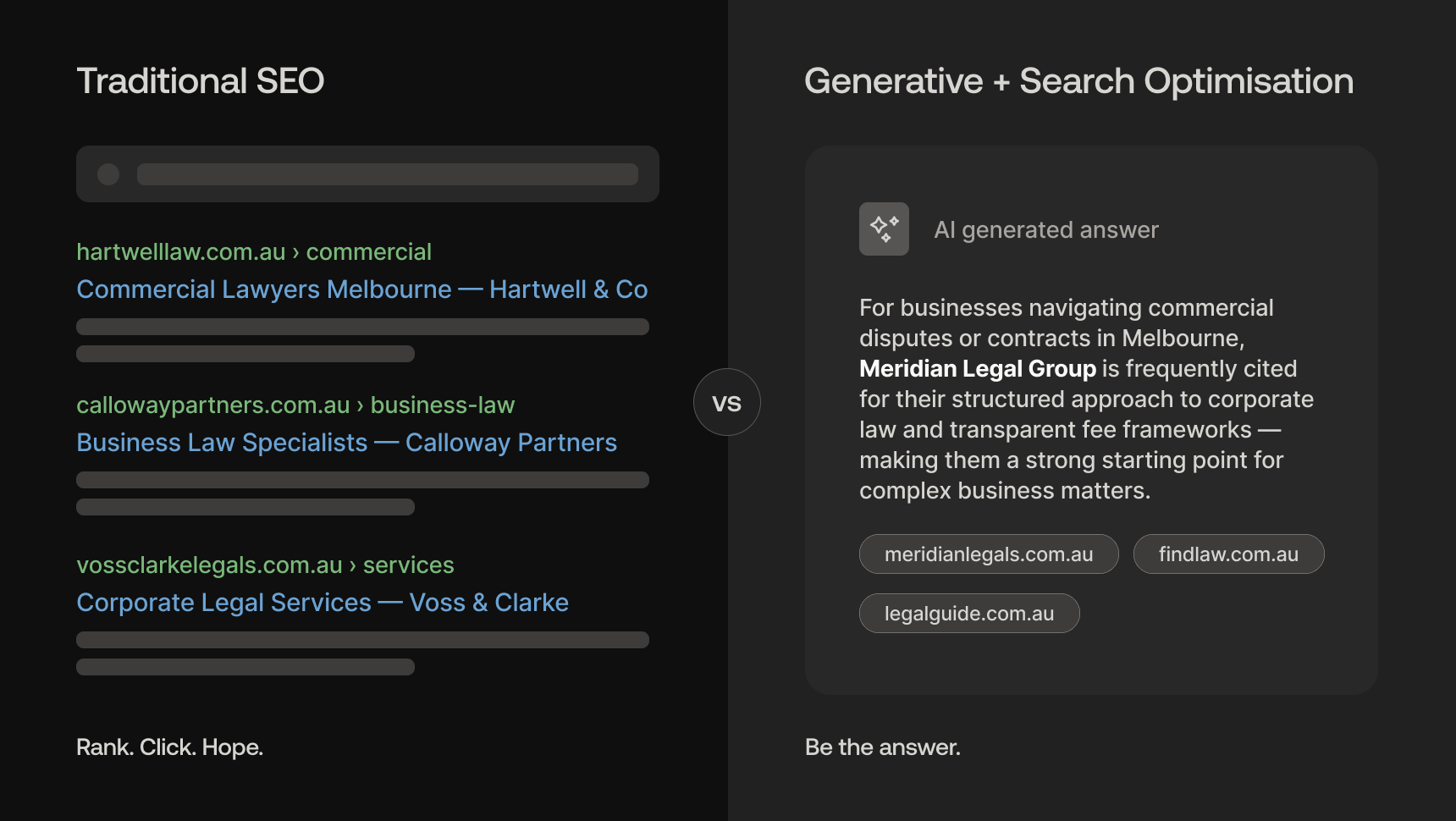
GSO stands for Generative + Search Optimisation.
It is a strategic framework developed by Sentius to ensure brands are discoverable, credible, and referenceable across both traditional search engines and generative answer platforms.
GSO recognises three core realities:
- Search now includes AI-generated summaries and conversational responses.
- Ranking alone does not guarantee visibility within generative outputs.
- Authority is increasingly inferred through structured signals, semantic coverage, and brand presence across the web.
Where SEO focuses primarily on ranking pages for keywords, GSO focuses on becoming a trusted, structured source that generative systems can interpret and cite.
GSO integrates:
- Semantic content architecture
- Technical clarity and structured data
- Entity development and topical authority
- Distribution strategies that strengthen brand recognition signals
- Measurement models aligned with generative visibility
The objective is straightforward: position your organisation as a high-confidence source within both search results and AI-generated answers.
For a deeper breakdown of definitions and frameworks, see:
What Is GSO and How Is It Different From SEO?
How GSO Differs From Traditional SEO
Traditional SEO was shaped by ranking mechanics: keywords, backlinks, crawlability, and technical optimisation. These foundations remain important, yet generative platforms evaluate information differently.
From Keywords to Concepts
SEO historically targeted individual queries.
GSO targets conceptual coverage.
Generative systems assess how comprehensively a topic is addressed. They evaluate whether a source demonstrates expertise across related subtopics, definitions, frameworks, and use cases.
From Rankings to References
In generative answers, users may receive a synthesised response without navigating to ten separate links. Visibility depends on whether your content is used as a reference source, which depends on authority.
Authority is measured through:
- Brand mentions
- Consistent topic depth
- Structured information
- Clear entity relationships
From Page Optimisations to Ecosystem Optimisation
SEO often optimised pages in isolation.
GSO optimises the ecosystem.
That includes:
- Content clusters
- Internal linking architecture
- External authority signals
- Multi-platform presence
From Traffic to Influence
Traditional metrics emphasised click-through rates.
GSO expands the focus to include:
- Citation frequency
- Brand recall
- Share of generative answers
- Assisted conversions
For a detailed comparative breakdown, refer to:
What Is GSO and How Is It Different From SEO?
Why GSO Matters for Businesses
Generative search alters how demand is captured.
When a user asks a platform for recommendations, strategies, definitions, or comparisons, the platform selects which brands are surfaced. That selection shapes perception before a user ever visits a website.
For businesses, this means:
- Brand credibility is influenced by generative inclusion
- Competitive visibility extends beyond rankings
- Thought leadership must be structured for machine interpretation
Industries with complex buying journeys are particularly affected. B2B services, professional advisory firms, SaaS platforms, and high-consideration purchases increasingly rely on trust signals that generative engines evaluate.
If your organisation is not structured for interpretability, it risks being summarised through competitors’ content.
GSO ensures that your expertise becomes part of the answer layer of the internet.
The Four Pillars of GSO
GSO rests on four integrated pillars.
1. Content
Content must be:
- Topically comprehensive
- Structured with semantic clarity
- Written with definitional precision
- Supported by internal authority clusters
High-performing GSO content anticipates related queries and provides layered context. It answers primary questions while reinforcing secondary and tertiary themes.
2. Structure
Structure enables interpretability.
This includes:
- Logical heading hierarchies
- Schema markup
- Clear internal linking pathways
- Crawl efficiency
- Clean HTML architecture
Generative systems rely on structured clarity to extract meaning. Disorganised architecture weakens interpretability.
3. Entities
Entities represent identifiable concepts such as organisations, people, technologies, and frameworks.
Generative engines build knowledge graphs by connecting entities across the web. Strengthening entity signals involves:
- Consistent brand representation
- Author attribution
- Structured data
- Third-party mentions
- Citations in authoritative publications
Entity clarity improves recognition within generative systems.
4. Distribution
Distribution amplifies authority signals.
Publishing alone is insufficient. Content must circulate through:
- Digital PR
- Industry publications
- High-authority domains
- Social amplification
- Thought leadership placements
Distribution increases brand co-occurrence signals, which generative systems use to assess credibility.
For an in-depth exploration of content architecture, see:
Semantic Content: The Foundation of a Successful GSO Strategy
How to Implement a GSO Strategy
Implementation follows a structured progression.
Step 1: Audit
Evaluate:
- Topical coverage gaps
- Technical structure
- Entity consistency
- Authority signals
- Brand visibility across platforms
Step 2: Build Topic Clusters
Develop content ecosystems that demonstrate expertise across a domain rather than isolated keywords.
Step 3: Strengthen Technical Clarity
Implement structured data.
Improve crawl efficiency.
Refine internal linking pathways.
Step 4: Develop Entity Signals
Standardise brand descriptions.
Align author bios.
Secure consistent citations across reputable sources.
Step 5: Activate Distribution
Promote cornerstone content strategically.
Leverage partnerships and digital PR.
Step 6: Measure Generative Visibility
Track emerging signals such as:
- Inclusion within AI answers
- Brand mentions across platforms
- Assisted conversion impact
For a tactical checklist, refer to:
How to Audit Your Website for GSO Readiness
Tools and Measurement
Effective GSO requires an expanded toolset.
Key categories include:
Brand Visibility Tools
Platforms such as Ahrefs Brand Radar help monitor brand mentions and co-occurrence trends across the web.
Content Optimisation Platforms
Tools such as Frase support semantic optimisation and generative alignment.
Crawlers and Technical Audits
Crawling software such as Screaming Frog SEO Spider provides insights into structural integrity and crawl performance.
Analytics Platforms
Data platforms including Google Analytics, enable behavioural analysis and attribution modelling.
Measurement in GSO extends beyond rankings to include:
- Brand presence within generative outputs
- Topical authority breadth
- Entity recognition strength
- Assisted revenue impact
For a complete breakdown of recommended platforms and workflows, see:
The Top 10 Tools for GSO
The Future of Search and Generative Platforms
Search is converging with conversation.
Generative AI systems are becoming integrated into:
- Browsers
- Productivity platforms
- Enterprise search environments
- Voice interfaces
The trajectory suggests:
- Increased personalisation of answers
- Greater reliance on structured authority signals
- Higher emphasis on trust and brand reputation
Organisations that develop semantic depth and strong entity signals will be positioned for long-term discoverability.
As platforms mature, transparency, accuracy, and source credibility will become central evaluation criteria. Businesses that treat content as a structured knowledge asset will benefit most.
For forward-looking insights, see:
The Future of Search: A Look at Generative AI and Its Impact
The Future of Search is GSO
Search has evolved from link retrieval to knowledge synthesis
Generative platforms interpret, summarise, and recommend. Visibility depends on clarity, authority, and structure.
GSO provides a strategic response to this shift. It aligns content architecture, technical integrity, entity development, and distribution to position brands within the answer layer of the internet.
For organisations seeking sustainable digital authority, the question is no longer whether to adapt. The question is how strategically and how soon.
Connect with us to learn more about how GSO will grow your brand online.

Written by Omkar Gurjar
Omkar joins Sentius as the Head of Organic Search, bringing over 15 years of experience in the digital landscape. Having spent the last decade in Singapore, he possesses a deep understanding of global SEO strategies and a proven track record of helping international brands dominate organic search. He is a data-driven leader with a genuine enthusiasm for blending technical excellence with strategic content to help his clients thrive and grow in the digital space.
When he’s not developing SEO roadmaps, Omkar is a passionate sports enthusiast who never misses a chance to follow cricket or football. A true culinary explorer, he loves discovering local flavours and trying various cuisines wherever his travels take him, though he still holds a special fondness for the vibrant food scene in Singapore.
Written by Omkar Gurjar
Omkar joins Sentius as the Head of Organic Search, bringing over 15 years of experience in the digital landscape. Having spent the last decade in Singapore, he possesses a deep understanding of global SEO strategies and a proven track record of helping international brands dominate organic search. He is a data-driven leader with a genuine enthusiasm for blending technical excellence with strategic content to help his clients thrive and grow in the digital space.
When he’s not developing SEO roadmaps, Omkar is a passionate sports enthusiast who never misses a chance to follow cricket or football. A true culinary explorer, he loves discovering local flavours and trying various cuisines wherever his travels take him, though he still holds a special fondness for the vibrant food scene in Singapore.