
How to Write Content for AI Chatbot Responses
Search has shifted from blue links to direct answers. AI chatbots, AI Overviews, and conversational interfaces now synthesise information from multiple sources and deliver structured responses in seconds.
For brands, this changes the optimisation target. You are no longer writing solely for ranking positions. You are writing to become the answer.
At Sentius, we approach this through Generative + Search Optimisation (GSO). Writing for AI chatbot responses is a core component of GSO. If your content is clear, structured, semantically rich, and entity-aware, it becomes easier for generative systems to interpret, trust, and cite.
This guide explains how to create content that AI chatbots can understand, extract, and confidently present to users.
The Growing Importance of Chatbot-Ready Content
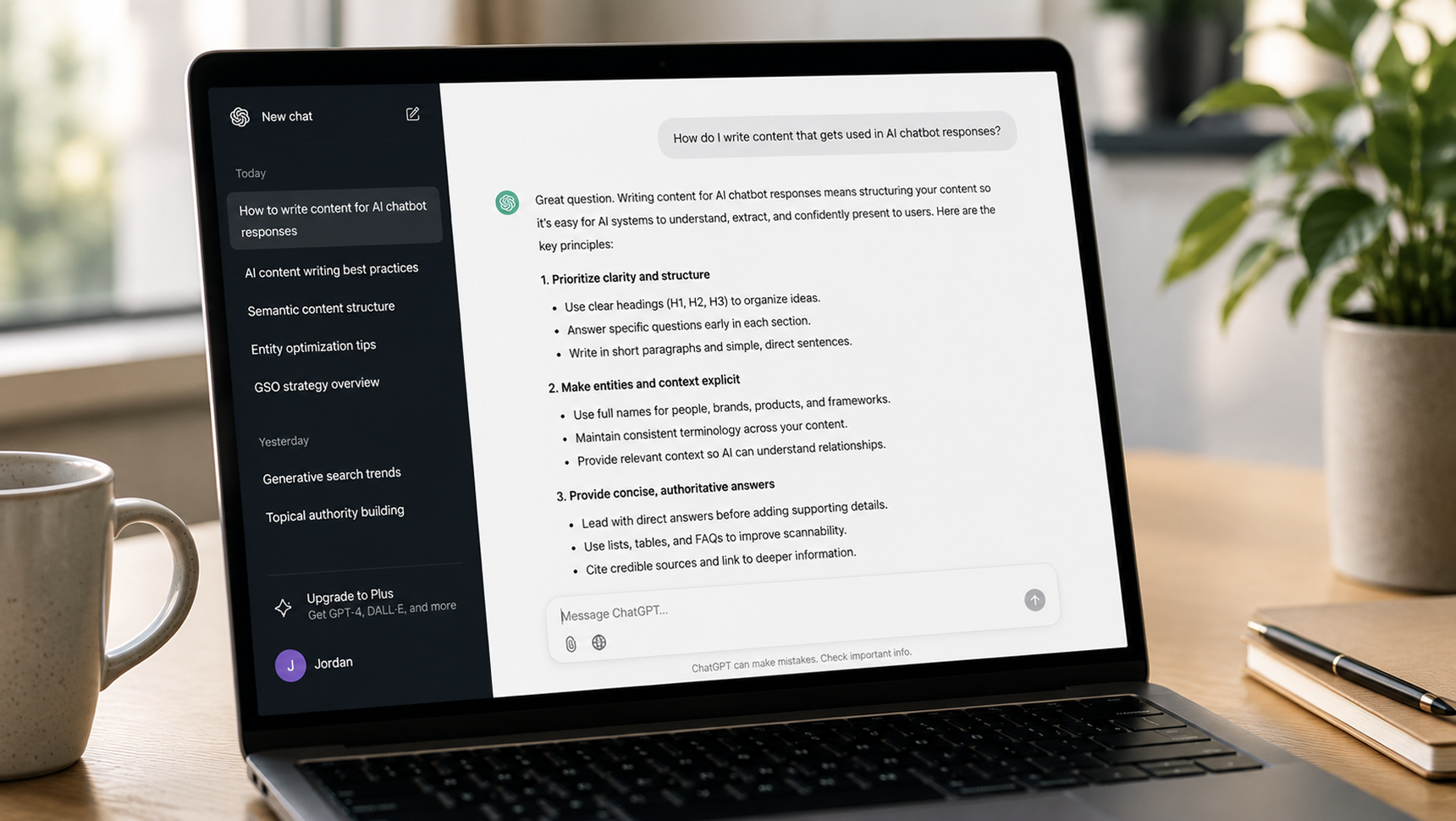
AI systems such as Google’s AI experiences, Microsoft Copilot, and large language model interfaces are increasingly shaping discovery. According to Google Search Central, modern search systems rely on natural language processing, entity understanding, and contextual relevance rather than keyword matching alone.
This shift matters for three reasons:
1. AI answers are compositional
Chatbots assemble responses by drawing from multiple high-quality sources. Clear, well-structured content increases your likelihood of being referenced within these synthesised answers.
2. Visibility is moving beyond rankings
A user may never click through if the chatbot provides a sufficient answer. Being cited, referenced, or reflected within generative summaries is now a visibility metric in its own right.
3. Trust and authority are algorithmically inferred
Generative systems rely heavily on signals such as:
- Entity clarity
- Topical depth
- Structured information
- External authority signals
- Internal knowledge consistency
This is why semantic architecture sits at the heart of chatbot optimisation. For a deeper exploration of this principle, see our guide to Semantic Content: The Foundation of a Successful GSO Strategy.
Writing for chatbots is not about gaming AI. It is about making your expertise legible to machine reasoning systems.
Structuring Content So AI Can Extract It
AI chatbots prioritise content that is easy to parse. Structure determines extractability.
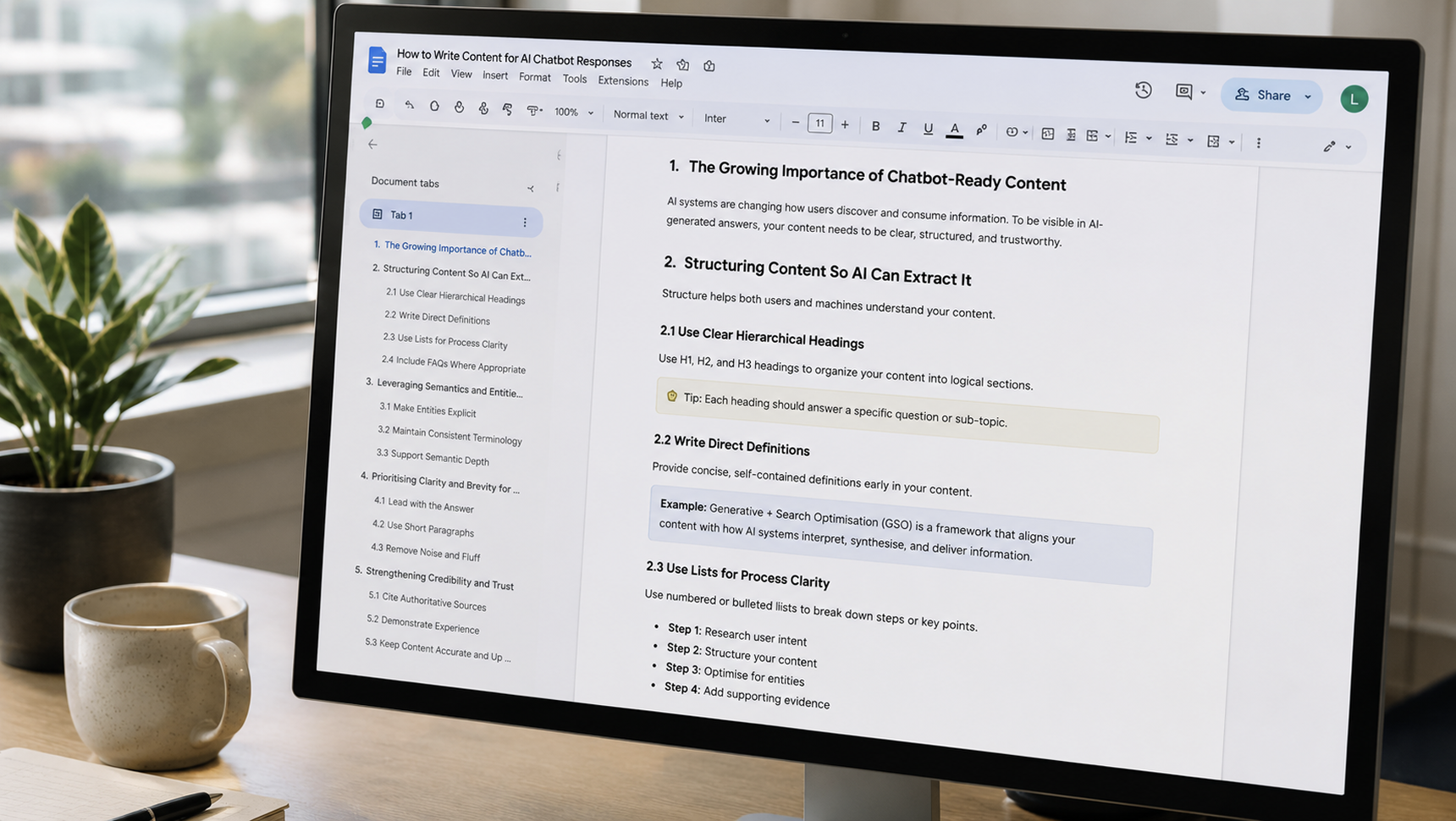
Use Clear Hierarchical Headings
Well-formed H1, H2, and H3 structures provide explicit topic segmentation. Each section should answer a specific sub-question. This mirrors how users ask conversational queries.
For example:
- What is GSO?
- How does GSO differ from SEO?
- How do you optimise for AI chatbots?
Each heading should reflect a discrete idea. Avoid vague headings such as “Learn More” or “Our Approach.”
Write Direct Definitions
AI systems frequently extract definitional passages. Include short, self-contained explanations early within sections.
Example format:
Generative + Search Optimisation (GSO) is a strategic framework that aligns brand’s online presence with how AI systems interpret, synthesise, and deliver information in conversational search environments.
This style improves excerpt quality and increases citation probability.
Use Lists for Process Clarity
Bulleted and numbered lists improve scannability for both users and machines. They also support multi-step reasoning models that break down complex tasks.
When explaining frameworks or processes:
- Present steps in logical order
- Keep phrasing consistent
- Avoid overly long sentences
Include FAQs Where Appropriate
AI chatbots frequently surface FAQ-style answers. Structured question-based content aligns closely with conversational queries and voice search patterns.
Leveraging Semantics and Entities for Machine Understanding
Modern search and generative systems rely heavily on entity recognition and semantic relationships.
An entity is a clearly identifiable concept such as:
- A brand
- A person
- A product
- A service
- A location
- An organisation
Google’s Knowledge Graph and similar systems map relationships between entities to understand context at scale. This means your content should explicitly reference and reinforce relevant entities rather than relying on vague pronouns or implied meaning.
Make Entities Explicit
Instead of writing:
Our framework improves visibility in AI search.
Write:
Sentius’ Generative + Search Optimisation framework improves brand visibility in AI-driven search environments such as Google AI Overviews and conversational chatbot platforms.
Clarity strengthens entity association.
Maintain Consistent Terminology
Use consistent naming conventions across your website. If your service is called “Generative + Search Optimisation,” avoid switching between multiple variations without explanation. Consistency improves machine-level understanding.
Support Semantic Depth
Semantic depth comes from covering related concepts within a topic cluster. For example, a page about chatbot optimisation may also reference:
- Structured data
- Natural language queries
- Entity-based ranking
- Conversational search
- Voice search optimisation
- Information retrieval models
This layered coverage signals topical authority.
To understand how entity modelling and semantic breadth support AI visibility, explore how we’ve achieved this through our GSO resource hub .
Prioritising Clarity and Brevity for AI Extraction
AI chatbots favour passages that are concise, precise, and self-contained.
Clarity improves extractability. Brevity improves quotability.
Write Self-Contained Paragraphs
Each paragraph should communicate a complete idea. Avoid long, winding explanations that require context from several sections to interpret.
Lead With the Core Insight
Place the most important statement at the beginning of a paragraph. Generative systems often weight early sentences more heavily during summarisation.
Avoid Redundancy
Repetition dilutes semantic strength. If you restate the same idea multiple times with minor variation, it becomes harder for models to identify the most authoritative phrasing.
Use Plain Language
Complex sentence structures increase cognitive load for both humans and AI systems. Clear, professional language improves comprehension and citation likelihood.
For a comprehensive understanding of how clarity underpins Generative + Search Optimisation, refer to The Definitive Guide to GSO.
Writing for the Answer Economy
AI chatbot optimisation is not a separate discipline from search. It is the natural evolution of it.
As conversational interfaces become embedded in search engines, productivity tools, and enterprise platforms, content must be structured for synthesis, not just ranking.
Within Sentius’ GSO framework, writing for AI chatbot responses involves:
- Clear hierarchical structure
- Strong definitional passages
- Explicit entity modelling
- Semantic depth across topic clusters
- Concise, extractable paragraphs
- Alignment with voice search optimisation
When content is architected with these principles in mind, it becomes easier for AI systems to interpret, reference, and trust.
In the new era of search, the objective is clear. Your content should not simply compete for position. It should be structured to become the answer.
Ready to get your content showing up where people are searching? Connect with us.

Written by Omkar Gurjar
Omkar joins Sentius as the Head of Organic Search, bringing over 15 years of experience in the digital landscape. Having spent the last decade in Singapore, he possesses a deep understanding of global SEO strategies and a proven track record of helping international brands dominate organic search. He is a data-driven leader with a genuine enthusiasm for blending technical excellence with strategic content to help his clients thrive and grow in the digital space.
When he’s not developing SEO roadmaps, Omkar is a passionate sports enthusiast who never misses a chance to follow cricket or football. A true culinary explorer, he loves discovering local flavours and trying various cuisines wherever his travels take him, though he still holds a special fondness for the vibrant food scene in Singapore.
Written by Omkar Gurjar
Omkar joins Sentius as the Head of Organic Search, bringing over 15 years of experience in the digital landscape. Having spent the last decade in Singapore, he possesses a deep understanding of global SEO strategies and a proven track record of helping international brands dominate organic search. He is a data-driven leader with a genuine enthusiasm for blending technical excellence with strategic content to help his clients thrive and grow in the digital space.
When he’s not developing SEO roadmaps, Omkar is a passionate sports enthusiast who never misses a chance to follow cricket or football. A true culinary explorer, he loves discovering local flavours and trying various cuisines wherever his travels take him, though he still holds a special fondness for the vibrant food scene in Singapore.