
Beyond Google: Optimising for Microsoft Copilot, Gemini, and Perplexity
Search behaviour is evolving rapidly. While Google remains dominant, users increasingly turn to conversational AI platforms such as Microsoft Copilot, Gemini, and Perplexity to research, compare, and validate decisions.
These platforms do not simply rank pages in a list. They synthesise information, generate answers, cite sources, and often personalise outputs based on context. Visibility within these systems depends on how clearly your content communicates meaning, authority, and structure.
Generative + Search Optimisation addresses this shift directly. As outlined in The Definitive Guide to GSO, modern search visibility is built on semantic clarity, entity authority, structured data, and technical accessibility. The same foundations apply beyond Google, but each platform interprets signals differently.
Understanding those differences is now essential for sustainable visibility — and is central to any GEO (generative engine optimisation) or AEO (answer engine optimisation) strategy.
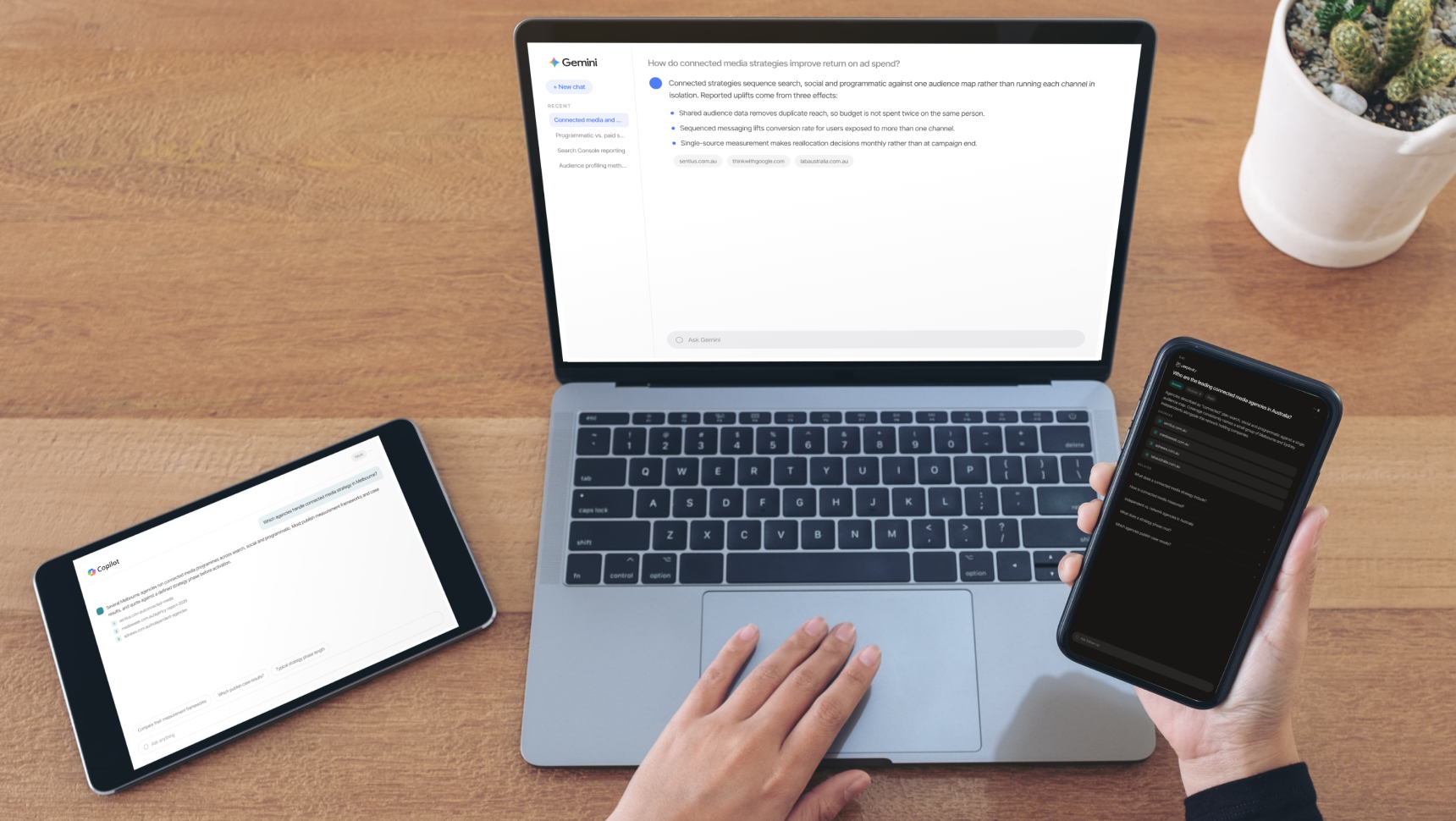
How Microsoft Copilot, Gemini, and Perplexity Retrieve and Generate Answers
Microsoft Copilot
Microsoft Copilot operates within the Microsoft ecosystem and is closely integrated with Bing search and Microsoft 365. It blends large language models with live web retrieval and Microsoft's ranking infrastructure.
Key characteristics include:
- Strong reliance on Bing's indexing and ranking signals.
- Integration with Microsoft Graph data in enterprise contexts.
- Clear citation behaviour within responses.
- Emphasis on freshness for news and commercial queries.
Because Copilot draws from Bing's search architecture, traditional technical SEO, structured data, and clear entity definition remain highly influential.
Gemini
Gemini operates within Google's ecosystem and integrates deeply with Google Search, Knowledge Graph systems, and AI Overviews.
Key characteristics include:
- Heavy use of Google's Knowledge Graph and entity relationships.
- Strong emphasis on E-E-A-T signals.
- Structured data interpretation at scale.
- Blending of generative summaries with traditional search results.
Content clarity, semantic consistency, and entity authority are critical here. Gemini rewards content that reinforces recognised entities and aligns with structured schemas supported by Schema.org.
Perplexity
Perplexity positions itself as an answer engine built around transparent citations. It retrieves information from across the web and presents synthesised responses with clear source attribution.
Key characteristics include:
- Strong citation transparency.
- Real time web retrieval.
- Preference for well structured, clearly attributable content.
- Conversational follow up refinement.
Perplexity tends to favour authoritative domains with clear structure, explicit definitions, and concise explanations. Citation likelihood increases when content is logically organised and semantically clear.

Differences in Ranking and Retrieval Signals
Although these platforms share generative models, their ranking foundations differ.
Infrastructure Dependence
- Copilot leans on Bing's indexing and ranking ecosystem.
- Gemini operates within Google's established entity graph and search signals.
- Perplexity aggregates and evaluates multiple web sources in real time.
Entity Authority Weighting
Gemini places strong weight on recognised entities within Google's Knowledge Graph. Copilot reflects Bing's entity modelling. Perplexity evaluates credibility through citation consistency and domain trust.
This means entity consistency across your site, structured markup, and clear brand definitions materially influence visibility.
Citation Behaviour
Perplexity and Copilot typically show explicit citations. Gemini often blends generative summaries with search features such as AI Overviews.
If your content lacks clear headings, definitions, or structured sections, citation probability decreases.
Freshness Sensitivity
Copilot and Perplexity tend to prioritise recent content for time sensitive queries. Gemini balances freshness with established authority signals.
Content strategy must therefore combine evergreen authority pages with timely updates.
Practical Optimisation Strategies Across All Three Platforms
Optimising for multiple generative platforms requires foundational alignment rather than platform specific manipulation.
1. Strengthen Semantic Structure
Use:
- Clear H1 and H2 hierarchy.
- Defined sections that answer discrete questions.
- Concise explanatory paragraphs.
- Explicit definitions of key terms.
This improves machine interpretability and citation likelihood. Find out more in our guide to Semantic Content.
2. Build Entity Clarity
Ensure:
- Your brand is consistently described across the site.
- Core services are defined as entities.
- Schema markup reinforces organisation, person, service, and article types.
Structured data supported by Schema.org helps search systems connect meaning at scale.
3. Improve Technical Accessibility
Maintain:
- Clean crawl architecture.
- Fast page load speeds.
- Logical internal linking.
- Clear canonicalisation.
Platforms relying on live retrieval reward technically accessible content.
4. Publish Citation Ready Content
Include:
- Data backed claims.
- References to reputable authorities such as government or academic sources.
- Clear summaries near the top of key pages.
Concise, well-structured explanations increase the probability of extraction into generative answers.
5. Balance Evergreen Authority with Fresh Updates
Develop:
- Pillar pages that define your core topics.
- Supporting articles that address emerging queries.
- Regular content refresh cycles.
Visibility in generative systems depends on both authority depth and recency signals.
These practices align directly with the principles outlined across our GSO framework.

Preparing for Multi Agent Search Systems
Search is moving toward multi agent environments where systems retrieve, evaluate, and synthesise information across multiple layers.
In this emerging model:
- One system retrieves relevant documents.
- Another evaluates authority and coherence.
- A generative model synthesises the final response.
This layered architecture increases the importance of structural clarity and entity coherence. Content that performs well across retrieval, evaluation, and synthesis stages will have durable visibility.
Future platforms are likely to integrate enterprise data, public web signals, and behavioural context simultaneously. Brands that build strong semantic foundations today will adapt more easily as retrieval models evolve.
The Strategic Imperative for Cross Platform Visibility
Optimising solely for Google search rankings no longer captures the full opportunity landscape. Microsoft Copilot, Gemini, and Perplexity each represent expanding surfaces where users research, validate, and make decisions.
A unified Generative + Search Optimisation (AI SEO) strategy ensures your brand:
- Is understood as a defined entity.
- Is technically accessible.
- Is structurally clear.
- Is citation ready.
This approach builds resilience across platforms and positions your business for sustained visibility in AI mediated search environments.
For a broader strategic perspective on why this matters commercially, explore Why Your Business Needs a GSO Strategy.
Search is becoming generative, conversational, and multi layered. Visibility now depends on clarity of meaning, strength of structure, and consistency of authority across every platform that interprets the web.
Want your brand to appear in searches beyond Google? Connect with us.