
The Difference Between E-E-A-T and GSO
Why This Distinction Matters in the AI Era
Search has shifted from ranking blue links to generating answers. Platforms such as Google’s AI Overviews and conversational engines increasingly synthesise information rather than simply index it. As a result, businesses need to understand two related but distinct concepts: E-E-A-T and GSO.
E-E-A-T is a quality framework used to evaluate content credibility. GSO, or Generative + Search Optimisation, is a strategic response to AI-driven search environments.
They are connected. They are not interchangeable.
Understanding the difference allows brands to build both trust and visibility in a landscape where AI systems summarise, interpret, and cite information in new ways.
Understanding E-E-A-T: Google’s Quality Benchmark
E-E-A-T stands for Experience, Expertise, Authoritativeness, and Trustworthiness. It appears in Google’s Search Quality Rater Guidelines, a public document that outlines how human evaluators assess content quality. You can review the official documentation via Google Search Central.
While E-E-A-T is not a direct ranking factor in the traditional algorithmic sense, it influences how Google evaluates the reliability and usefulness of content, particularly in high impact categories such as finance, health, and legal advice.
Each component plays a distinct role:
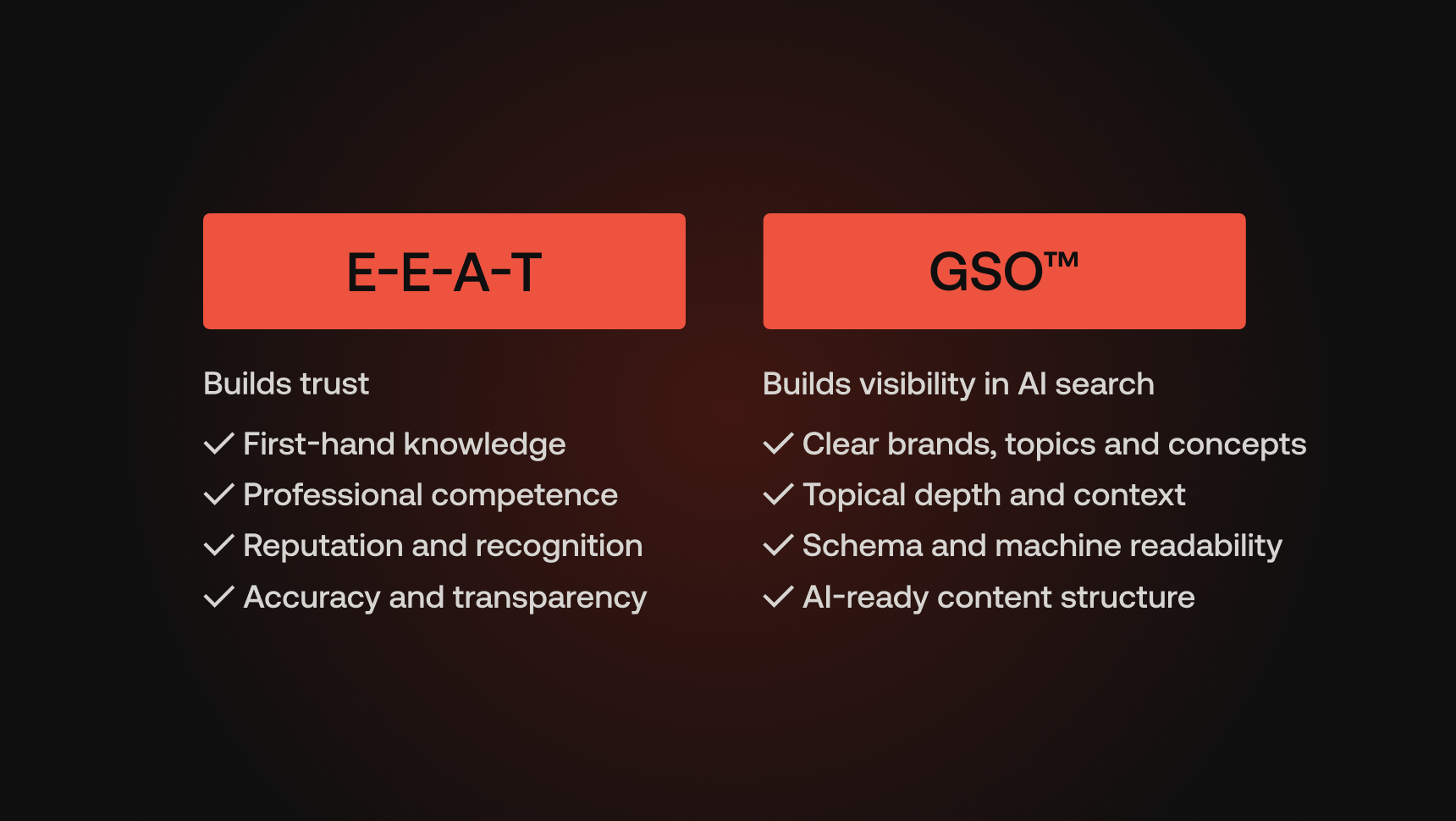
- Experience refers to first-hand knowledge or lived involvement with a topic
- Expertise reflects depth of knowledge or professional competence
- Authoritativeness relates to reputation and recognition within a field
- Trustworthiness underpins everything, covering accuracy, transparency, and integrity
E-E-A-T focuses primarily on credibility signals. These include author bios, citations, backlinks from reputable sources, secure websites, and transparent business information.
In practical terms, E-E-A-T asks the question: Can this source be trusted?
It does not define how AI systems structure responses. It does not prescribe semantic architecture. It does not determine how content becomes machine-readable at scale. That is where GSO enters the picture.
What GSO Optimises For in Generative Search
Generative + Search Optimisation expands beyond credibility into discoverability within AI systems.
GSO focuses on how content is interpreted, structured, and surfaced by generative models. It aligns technical SEO, semantic content architecture, entity clarity, and structured data to improve inclusion in AI-generated answers.
Where E-E-A-T evaluates quality, GSO engineers visibility.
Core components of GSO include:
- Entity-based content modelling
- Semantic depth and contextual layering
- Structured data implementation
- Clear answer formatting for conversational queries
- Distribution across authoritative ecosystems
This strategic framework is explored in greater detail within our guide to Semantic Content, which outlines how topic architecture and entity clarity improve machine comprehension.
Generative systems do not simply crawl pages. They extract meaning. They map relationships. They summarise across multiple sources.
GSO ensures that when AI systems interpret a topic, your brand is structurally positioned to be understood and referenced.
In practical terms, GSO revolves around the question: Is this content structured in a way AI systems can confidently use?
Where E-E-A-T and GSO Overlap
E-E-A-T and GSO intersect in meaningful ways.
AI models are trained on vast corpora of high quality, authoritative information. Trust signals influence which domains are frequently referenced and reinforced in training data. This creates a natural overlap between credibility and generative inclusion.
For example:
- A brand with strong backlinks from reputable institutions strengthens Authoritativeness under E-E-A-T and improves entity prominence under GSO
- Transparent authorship improves Trustworthiness while also enhancing knowledge graph clarity
- Detailed, experience-driven content satisfies Experience criteria and enriches semantic depth
However, overlap does not mean equivalence.
A website may demonstrate strong E-E-A-T yet lack the structural optimisation needed for generative systems. Conversely, technically structured content without credible authority will struggle to gain strong E-E-A-T.
E-E-A-T builds trust.
GSO builds structured accessibility within AI environments.
Together, they form a comprehensive strategy.
Which Has Greater Influence in AI-Driven Search?
The more relevant question is not which matters more, but how each contributes to visibility.
AI systems synthesise information from sources that are both credible and structurally clear. Without E-E-A-T, content lacks authority signals. Without GSO, content lacks generative readiness.
In AI-driven search environments:
- E-E-A-T influences whether a source is deemed reliable
- GSO influences whether a source is extractable and structurally suitable for AI answers
For organisations adapting to generative search, prioritising GSO provides a tactical advantage because it addresses how answers are assembled. It translates credibility into machine-compatible structure.
This is explored more comprehensively inThe Definitive Guide to GSO, which outlines how semantic modelling, structured data, and entity alignment underpin AI visibility.
In short:
E-E-A-T establishes why your content deserves trust.
GSO determines how your content becomes part of the answer.
Both are essential. The competitive advantage lies in integrating them.
Building a Unified Strategy for the AI Search Landscape
As search evolves, credibility and structure must operate together.
E-E-A-T remains foundational. It safeguards content quality and reinforces long term authority.
GSO operationalises that authority within generative systems. It ensures that semantic clarity, structured data, and entity relationships are aligned with how AI retrieves and composes answers.
For brands investing in future search visibility, the pathway is clear:
- Establish demonstrable experience and expertise
- Strengthen authority through reputable citations and digital reputation
- Architect content semantically for AI comprehension
- Implement structured data to reinforce entity clarity
- Distribute content across authoritative ecosystems
This integrated approach reflects the direction of search itself. AI is not replacing trust. It is amplifying the need for it while reshaping how it is discovered.
Understanding the difference between E-E-A-T and GSO allows organisations to move beyond surface level optimisation and build systems that perform in both traditional and generative environments.
The brands that succeed will not treat them as alternatives. They will treat them as complementary pillars of modern search strategy.
Want to optimise your online presence for the new era of AI search? Connect with us.

Written by Omkar Gurjar
Omkar joins Sentius as the Head of Organic Search, bringing over 15 years of experience in the digital landscape. Having spent the last decade in Singapore, he possesses a deep understanding of global SEO strategies and a proven track record of helping international brands dominate organic search. He is a data-driven leader with a genuine enthusiasm for blending technical excellence with strategic content to help his clients thrive and grow in the digital space.
When he’s not developing SEO roadmaps, Omkar is a passionate sports enthusiast who never misses a chance to follow cricket or football. A true culinary explorer, he loves discovering local flavours and trying various cuisines wherever his travels take him, though he still holds a special fondness for the vibrant food scene in Singapore.
Written by Omkar Gurjar
Omkar joins Sentius as the Head of Organic Search, bringing over 15 years of experience in the digital landscape. Having spent the last decade in Singapore, he possesses a deep understanding of global SEO strategies and a proven track record of helping international brands dominate organic search. He is a data-driven leader with a genuine enthusiasm for blending technical excellence with strategic content to help his clients thrive and grow in the digital space.
When he’s not developing SEO roadmaps, Omkar is a passionate sports enthusiast who never misses a chance to follow cricket or football. A true culinary explorer, he loves discovering local flavours and trying various cuisines wherever his travels take him, though he still holds a special fondness for the vibrant food scene in Singapore.